
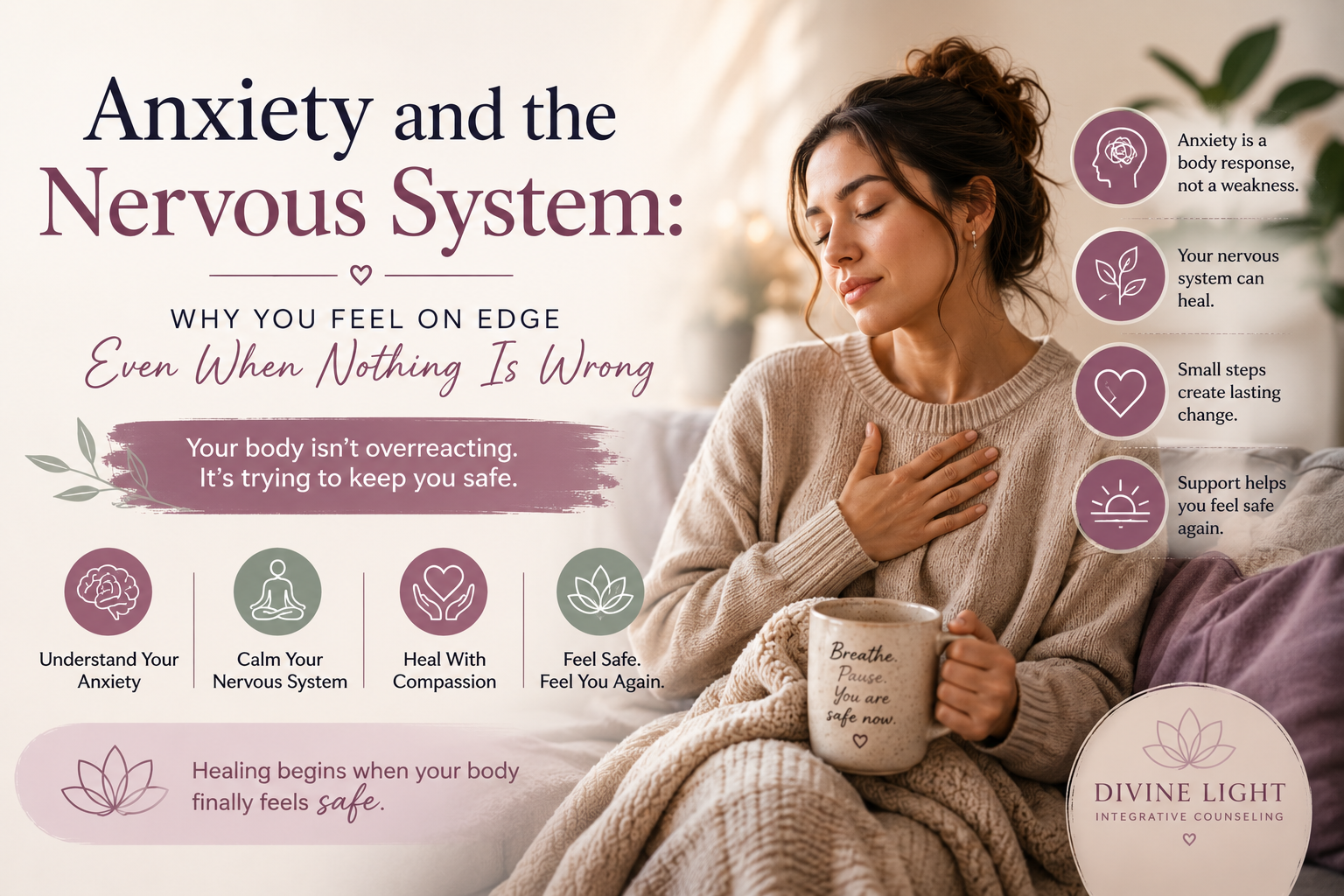
Anxiety and the Nervous System: Why You Feel On Edge Even When Nothing Is Wrong
Have you ever felt anxious even when nothing serious was happening?
You may be sitting at home, lying in bed, driving, working, or talking to someone, and suddenly your body feels tense. Your chest may feel tight. Your mind may start racing. You may feel restless, overwhelmed, or unable to relax.
Then you look around and think, “Nothing is wrong, so why do I feel this way?”
This is one of the most confusing parts of anxiety. From the outside, everything may seem normal. But inside, your nervous system may be acting as if there is danger.
Anxiety is not always a sign that something is wrong in the present moment. Sometimes, it is a sign that your body has learned to stay alert for too long.
As a psychologist and healer, I have seen many people blame themselves for being anxious, sensitive, or unable to “calm down.” But anxiety is not a weakness. It is often the nervous system asking for safety, support, and deeper healing.
If you have been exploring emotional triggers after trauma, this article will help you understand why anxiety can feel so strong in the body.
Anxiety Is Not Just in Your Mind
Many people try to think their way out of anxiety.
They tell themselves, “I am fine.”
They try to stay positive.
They try to ignore the feeling.
They may even judge themselves for not being able to relax.
But anxiety is not only a thought pattern. It is also a body response.
Your nervous system controls how your body responds to stress, safety, and danger. When your nervous system feels safe, your body can rest, think clearly, breathe deeply, and feel connected.
But when your nervous system feels threatened, it may move into survival mode. Your body may prepare to fight, run, freeze, or please others, even when there is no clear danger around you.
This is why anxiety can feel so physical. It may show up as a fast heartbeat, tight chest, stomach discomfort, muscle tension, shallow breathing, sweating, shaking, or difficulty sleeping.
You are not imagining it. Your body is responding.
Why Anxiety Can Stay Even After the Problem Is Gone
Sometimes anxiety continues because the body has not received the message that it is safe now.
This can happen after trauma, emotional stress, relationship pain, childhood wounds, burnout, grief, or long periods of pressure. Even when the situation has passed, the nervous system may still stay alert.
For example, if you spent a long time needing to be careful, strong, responsible, or emotionally prepared, your body may struggle to relax. Calm may even feel unfamiliar.
You may notice that when things finally become quiet, your anxiety gets louder.
This does not mean you are broken. It may mean your body is used to surviving, not resting.
Healing begins when you stop fighting your anxiety and start listening to what it is trying to communicate.
Common Signs Your Nervous System Is Overloaded
Your nervous system may be overloaded if you feel constantly tense, even during normal moments.
You may overthink small conversations. You may feel exhausted but unable to rest. You may become easily irritated, emotional, or overwhelmed. You may struggle with sleep because your mind keeps replaying the day or preparing for tomorrow.
You may also feel like you are always waiting for something bad to happen.
This can be especially common for people who have lived in survival mode for a long time. You may want peace, but your body may still be scanning for danger.
If this feels familiar, you may also connect with the article on survival mode and deeper healing.
How Anxiety Affects Emotional Regulation
When anxiety is active, emotional regulation becomes harder.
You may react faster than you want to. You may cry more easily. You may shut down during conversations. You may become defensive, distant, or overly apologetic.
This happens because anxiety reduces your sense of inner safety. When the nervous system feels threatened, the body prioritizes protection over calm communication.
This is why emotional regulation is not about forcing yourself to be calm. It is about helping your body feel safe enough to respond differently.
Mindfulness, grounding, breathing, self-compassion, and trauma-informed healing can all help create that safety over time.
If you are working on becoming more present with your emotions, you can also read about mindfulness for stress and anxiety.
The Link Between Anxiety and Self-Criticism
Many people with anxiety are also very hard on themselves.
They may think:
“Why am I like this?”
“I should be stronger.”
“I should be over this by now.”
“I am too sensitive.”
“I always ruin things.”
But self-criticism usually makes anxiety worse.
When you attack yourself for feeling anxious, your body receives more stress, not safety. The nervous system may become even more activated because now the threat is not only outside you. It is also coming from your own inner voice.
Self-compassion helps interrupt this cycle.
Instead of saying, “I should not feel this way,” try saying, “My body is having a hard moment, and I can support myself through it.”
This creates emotional safety from within.
For more support with this, read healing through self-compassion.
Why Your Body Needs Safety Before It Can Relax
You cannot force a nervous system to feel safe by simply telling it to calm down.
Safety is built through repeated experiences of care, grounding, connection, and emotional support.
This may include taking slow breaths, setting boundaries, speaking kindly to yourself, reducing overstimulation, resting without guilt, spending time in calming environments, and receiving support from someone who understands trauma-informed healing.
Your body learns through repetition.
Each time you pause instead of panic, breathe instead of rush, and support yourself instead of judge yourself, you teach your nervous system that it does not have to stay on alert all the time.
Healing does not happen through pressure. It happens through safety.
Practical Ways to Calm Anxiety in the Body
When anxiety rises, start with your body before trying to solve everything in your mind.
Place both feet on the floor. Notice the ground underneath you. Take a slow breath in and a longer breath out.
Look around the room and name five things you can see. This reminds your brain that you are in the present moment.
Then gently place one hand on your chest or stomach and say:
“I am here.”
“I am safe in this moment.”
“This is anxiety, not danger.”
“I can take one small step at a time.”
You can also try writing down what your anxiety is saying. Sometimes the anxious part of you needs to be heard, not silenced.
Ask yourself:
“What is my anxiety trying to protect me from?”
“What does my body need right now?”
“What would feel supportive in this moment?”
These questions help you move from fear into awareness.
A Simple Nervous System Reset Practice
Try this practice when you feel overwhelmed or on edge.
First, sit comfortably and let your shoulders drop.
Second, inhale slowly through your nose for four seconds.
Third, exhale slowly for six seconds.
Fourth, repeat this five times.
Fifth, look around and remind yourself where you are. Say the date, the room you are in, and one thing that makes you feel grounded.
Then say:
“I do not have to solve my whole life right now. I only need to return to this moment.”
This practice may seem simple, but it helps your body shift from survival into presence.
When to Seek Support for Anxiety
Sometimes anxiety becomes difficult to manage alone.
If anxiety is affecting your sleep, relationships, work, decision-making, or daily peace, it may be time to receive deeper support.
A therapist for anxiety can help you understand the root of your anxiety, identify emotional patterns, regulate your nervous system, and build healthier coping tools.
Holistic and trauma-informed support can be especially helpful when anxiety is connected to past pain, emotional wounds, relationship triggers, or long-term stress.
You do not have to wait until things feel unbearable before asking for help. Support is not only for crisis. Support is also for growth, clarity, and healing.
You can explore Krystal’s holistic healing services to learn more about emotional support, anxiety healing, trauma-informed care, and self-awareness.
Want to Understand Your Patterns More Deeply?
Sometimes anxiety is connected to deeper emotional patterns, limiting beliefs, or old wounds.
If you are unsure what may be affecting your healing journey, you can take the self-awareness quiz to begin exploring your inner blocks, relationship patterns, and emotional needs.
Conclusion: Anxiety Is a Signal, Not a Personal Failure
Anxiety can feel frustrating, exhausting, and confusing. But it is not a sign that you are weak.
It is often a signal from your nervous system.
Your body may be asking for rest.
Your emotions may be asking for care.
Your mind may be asking for safety.
Your spirit may be asking for reconnection.
When you begin to understand anxiety as a message instead of an enemy, healing becomes softer. You stop fighting yourself and begin supporting yourself.
You do not have to rush your healing. You do not have to have everything figured out. You can begin with one breath, one pause, one kind thought, and one gentle step back into safety.
If you are ready to understand your anxiety and begin a deeper healing journey, book a consultation with Krystal Ortiz Divine Light for trauma-informed support, emotional balance, and nervous system healing.